ICM v3.0 and Messagebook V2.9
EUCARIS published new validation rules, including relaxed checks for the Incomplete and Completed stages. The platform runs on these versions.
 A service of CHTS
Electronic Certificate of Conformity
One platform for vehicle manufacturers and bodybuilders. You provide the vehicle data; the platform checks it, builds the eCoC, signs it with your certificate and sends it to the European registration authorities.
Sample data
Timeline
Europe opted for a transition period. From 29 November 2026 the eCoC is definitively mandatory. Some countries may still ask for a paper CoC or a print-out as well.
In the European Motor Vehicles Working Group, Member States agreed a transitional arrangement: as the Member States' national infrastructure was not yet ready, the paper CoC may be used until 29 November 2026 at the latest.
IVI 2.0 becomes the standard for the electronic CoC of vehicles under (EU) 2018/858.
For category M, N and O vehicles produced on or after this date, every eCoC must be digitally signed by the manufacturer or its EU representative. Files in IVI version 1.x are no longer accepted.
In several Member States: no eCoC, no registration (for example in the Netherlands). Exempt are national small series and categories L, T, C, R, S and U.
Why this matters now
The move from the paper Certificate of Conformity (CoC) to the electronic CoC (eCoC) is part of the wider digitalisation of European vehicle registration. The aim is to make the exchange of vehicle data between manufacturers, national approval authorities and registration authorities faster, more reliable and more efficient.
The eCoC brings many benefits:
Producing an eCoC does take work: building XML files, meeting hundreds of validation rules, managing a qualified certificate and working through rejections with error codes. e-coc.be takes that work off your hands. You work in a web application; the platform enforces the rules.
How it works
Enter the data on screen or upload a file. Fixed type data only needs to be entered once.
The platform checks the record against the IVI 2.0 rules before sending and shows what is missing or wrong.
The eCoC is assembled from the right template for each vehicle category and regulation.
Signed with your own qualified certificate (eIDAS), stored securely in a key vault.
Submitted through the RDW access point to EUCARIS. You see the acknowledgement and everything stays traceable.
The platform
Swipe to see the full screen · tap to enlarge
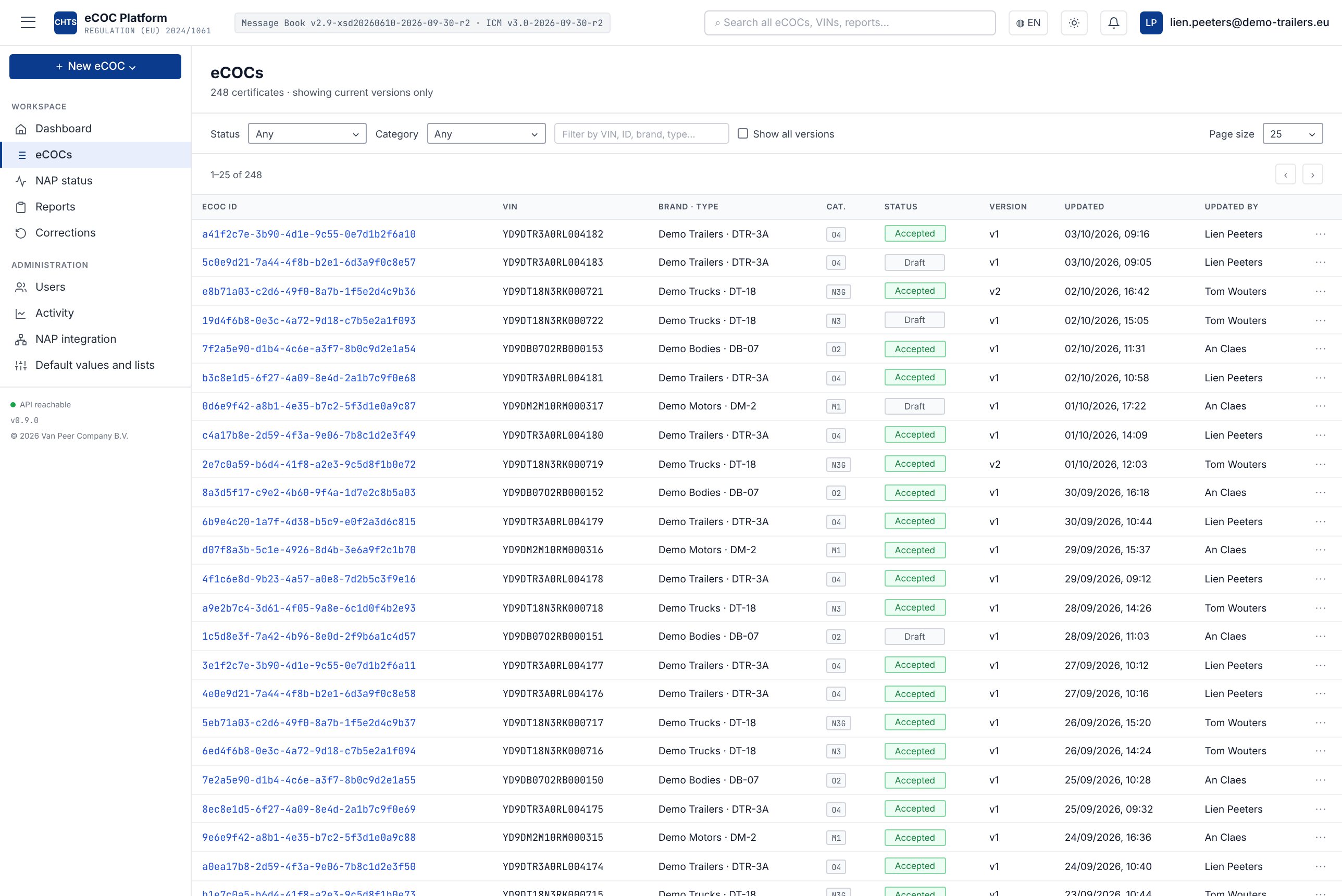
All records in one place, with status, version and who changed it last.
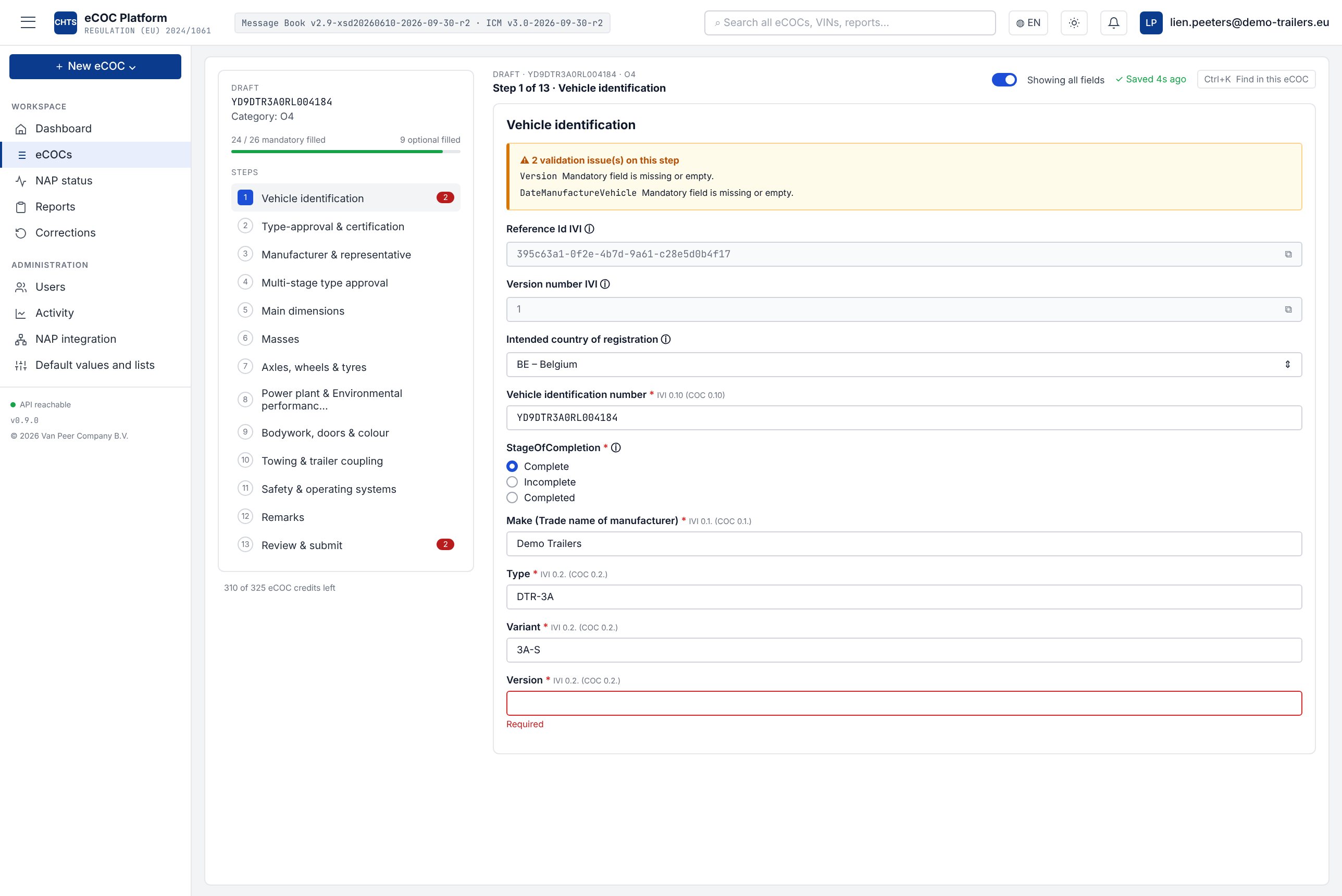
Each step shows only the fields for your category, with the IVI and CoC reference. Missing fields are flagged straight away.
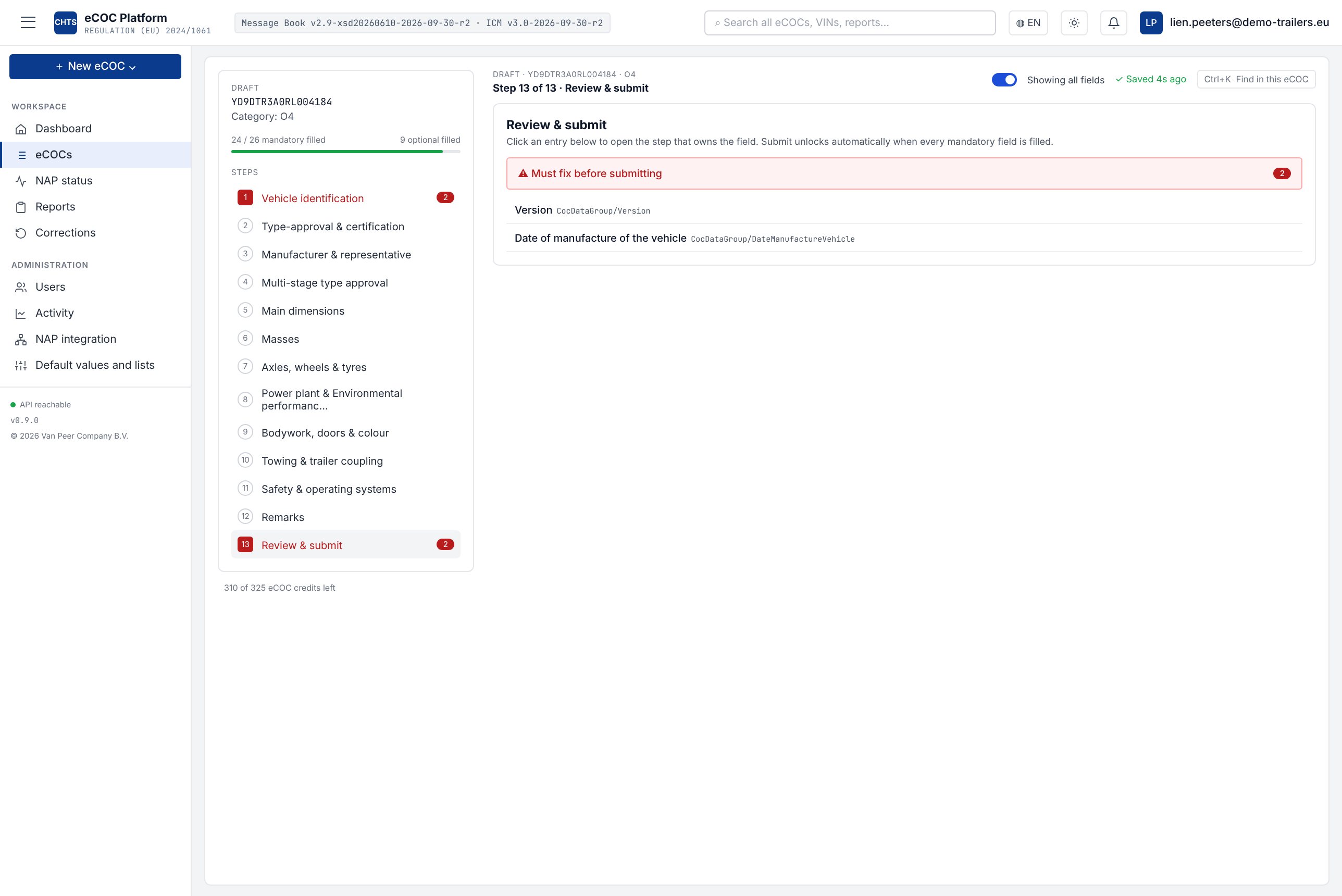
The last step lists what still needs doing. Submitting unlocks only once every mandatory field is filled.
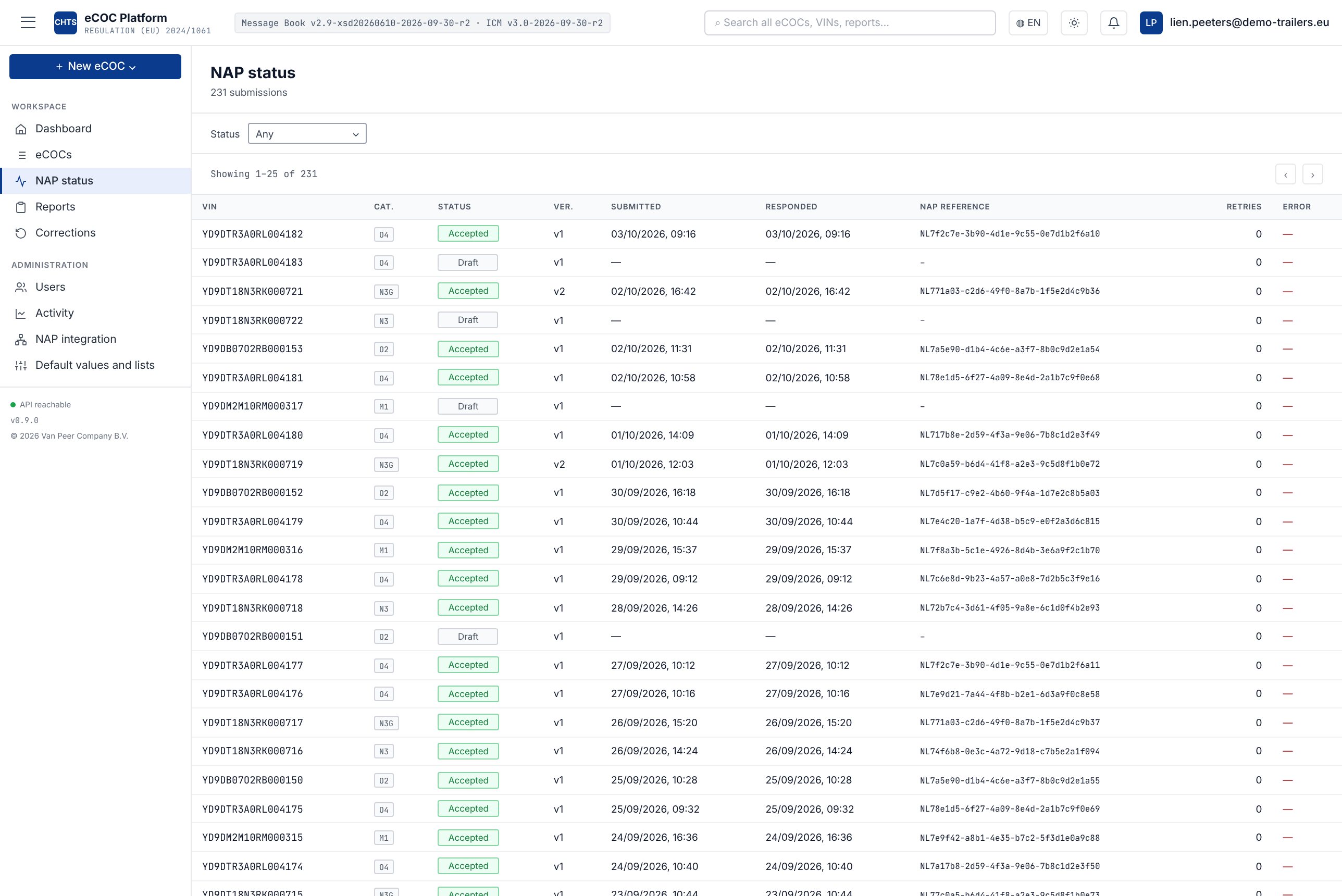
For each vehicle you see the status, when it was submitted and answered, and the NAP reference.
Screenshots of the platform, with fictitious sample data.
Features
Signing certificate
Every eCoC must be signed with a qualified electronic seal (eIDAS) in your company's name. For this we work with a recognised European certificate provider (qualified trust service provider).
We create the key in the platform's secure key vault and prepare the request. The private key never leaves that vault.
The provider verifies your company details directly with you, based on the company register (KBO/BCE, KvK, …). No token or extra hardware.
The provider delivers the certificate as a file. We link it to your account, after which you can sign and submit.
The certificate is valid for up to three years. The platform warns you well in advance when renewal is due.
Important: your company name must be written identically in the company register, on your type-approval and on the certificate. We check this before the request, so you lose no time.
What you get
Cars, buses, commercial vehicles and trailers. The right fields per category, from 179 to 324, and only those.
Every IVI code value is available as a pick list. No typos in codes that the RDW rejects later.
The platform checks your record against the IVI and ICM rules and only allows sending once blocking errors are resolved.
Record a vehicle type once and duplicate it per VIN. You only fill in what differs.
Your signing certificate is kept in a secure key vault. The private key is never downloaded or shared.
You see well in advance when your certificate expires, so submissions never stall.
Rejected or changed? You create a new version. Who did what and when stays visible in the audit trail.
Sign-in with two-factor authentication. Your data is strictly isolated from other manufacturers.
The choice
| Own connection | Generic software package | e-coc.be | |
|---|---|---|---|
| Connection to RDW and EUCARIS | Arrange it yourself: transport certificate, secure connection, acceptance testing with the RDW. | Depends on the vendor. | ✓Already set up and tested. You join a working chain. |
| Connection to your ERP or own system | Build and maintain it yourself. | Depends on the vendor. | ✓Custom connection built by us, based on a separate quote. |
| Keeping up with IVI rules | Every new version or rule change is an IT project of its own. | Updates on the vendor's schedule. | ✓Updated centrally for all users, with no work on your side. |
| Type-approval expertise | Needs to be in-house or hired in. | Usually a software house, not a technical service. | ✓A technical service that knows your files and the regulations. |
| Help with your certificate | Figure it out yourself. | Often limited to the software. | ✓Guidance with application, installation and renewal. |
| Multi-stage and limited volumes | Possible, but you build every scenario yourself. | Often geared to large volumes. | ✓Built for limited volumes and multi-stage vehicles. |
| Upfront investment | Development, testing and maintenance at your own cost. | Licence plus implementation. | ✓No development costs. You pay for use. |
| Time to first eCoC | Months. | Weeks to months. | ✓As soon as your certificate and account are ready. |
Working with an ERP or your own system? We connect the platform to it, so your vehicle data flows straight into the eCoC. A connection is custom work and is quoted separately.
Who it is for
Own type-approval, limited volumes, no appetite for an in-house IT project.
Completing a base vehicle, with the right stage and a reference to the previous one.
Trailers and semi-trailers, with fixed type data and fast entry per VIN.
Who supply certificates in Europe on behalf of a manufacturer.
Accreditation scope: Inspection (17020) · Testing (17025)
About CHTS
CHTS was founded in 2018 and has grown into a recognised technical service in the automotive sector. From Nossegem (Zaventem), a team of experienced specialists works every day on the technical approval of vehicles and vehicle components.
With e-coc.be, CHTS brings that type-approval expertise straight to the electronic CoC: you work with people who know your files and the regulations.
e-coc.be is a service of CHTS. You work with people who know the regulations and inspection practice.
Applying for a qualified signing certificate is new to many manufacturers. We guide you step by step.
A web platform with its own users per company. Your data stays separate from other manufacturers.
Checklist
Tick what is already in place. You immediately see what is left to do.
Still a lot to arrange. Start in time: seal validation and the RDW check alone take a few weeks.
Request a quoteUpdates
EUCARIS published new validation rules, including relaxed checks for the Incomplete and Completed stages. The platform runs on these versions.
European Member States extended the transition to the electronic CoC. From 29 November 2026 the digitally signed eCoC is the only route.
Manufacturers can request their qualified seal from a recognised European provider, linked to the platform's secure key vault.
Questions
The electronic Certificate of Conformity. It confirms that a vehicle conforms to its approved type, and replaces the paper CoC with a digital, signed message.
IVI stands for Initial Vehicle Information: the European message format in which the eCoC is produced. Version 2.0 is the current standard; files in version 1.x are no longer accepted for new vehicles.
The national access point (NAP) receives your eCoC and forwards it through the EUCARIS network to the registration authorities of other Member States. e-coc.be submits through the RDW NAP.
After a European transition period, the digitally signed eCoC is mandatory for category M, N and O vehicles produced on or after 29 November 2026.
Yes. The eCoC is signed with a qualified certificate in your company's name. That certificate is yours, whichever channel you submit through. We work with a recognised European certificate provider for this and guide you through the application and the link with the platform.
No. You work in your browser. You invite colleagues yourself and decide who can do what.
You receive a notification with the reason. You correct the record in the platform and send a new version. The full history is kept.
Yes. You record the fixed type data once, then per vehicle you only fill in what differs.
That depends on your volumes and number of vehicle types. In a short demo we look at your situation, after which you receive a tailored proposal.
Request a quote or book an online demo. You will find both on the CHTS eCOC page.